The dealer told Maya her new car would cost $389 a month. The contract said $412. Nobody had lied to her. They had just shown her the number she wanted to see, and left the rest for the paperwork.
That gap is why an auto loan calculator matters. Not the one on the dealer's screen. Your own, run before you walk in, with numbers you chose yourself. Five minutes with it can save you thousands, and it changes the question from "can I afford the monthly payment?" to "what does this car actually cost me?"
This guide shows you how an auto loan calculator works, which four numbers it needs, and what the answers mean, with a real worked example.
An auto loan calculator takes the details of a car loan and turns them into three answers: your monthly payment, the total interest you will pay, and the total cost of the car once the loan is done.
Those three numbers answer three different questions. The monthly payment tells you if the loan fits your budget this month. The total interest tells you what the loan costs you over its whole life. The total cost tells you what the car really costs, not what the sticker says.
Most buyers only look at the first number. That is the trap. A longer loan can make almost any car look affordable month to month, while quietly adding thousands in interest. The calculator shows all three at once, so you judge the whole deal, not one friendly-looking figure.
A calculator is only as honest as the numbers you feed it. You need four.
Get these four numbers straight before you start, and the calculator will give you answers you can trust. Guess at them, and it gives you a neat-looking fiction.
Let us run one real example all the way through, so you can see how the pieces fit together.
Say you are buying a car for $28,000. You put $4,000 down, so you borrow $24,000. The lender offers 6.5% APR over 60 months, which is five years.
Put those numbers into an auto loan calculator and you get a monthly car payment of about $470. Over 60 months you pay $28,175 in total, so $4,175 of that is interest. The $28,000 car actually costs you $32,175 by the time it is yours, once the down payment and interest are counted.
That is the number that matters. Not $470 a month. $32,175 in total, for a $28,000 car, and that is with a decent rate and a sensible down payment. Change any one of the four inputs and the total moves, sometimes a lot.
The term is the lever dealers pull most often. "We can get that payment down," they say, and they do it by stretching the loan. Here is what that does to the same $24,000 loan at 6.5% APR.
| Loan term | Monthly payment | Total interest | Total paid |
|---|---|---|---|
| 36 months | $736 | $2,481 | $26,481 |
| 48 months | $569 | $3,320 | $27,320 |
| 60 months | $470 | $4,175 | $28,175 |
| 72 months | $403 | $5,048 | $29,048 |
Look at the jump from 36 months to 72 months. The payment drops by $333 a month, which feels like a big win. But the total interest more than doubles, from $2,481 to $5,048. You pay $2,567 extra for the privilege of paying less each month.
There is nothing wrong with a 60-month loan if that is what your budget needs. But a 72-month loan on a car you will probably sell after four or five years is a different story. Cars lose value fastest in the first few years, and a long loan can leave you owing more than the car is worth, so you cannot sell a car you no longer want.
A good rule for the showroom: pick the shortest term whose monthly payment you can honestly afford, and run the calculator on that term first.
Now keep everything the same, the $28,000 car, 6.5% APR, 60 months, but take away the $4,000 down payment and borrow the full $28,000.
The monthly payment rises from about $470 to about $548. That is $78 more every month. The total interest rises from $4,175 to $4,871, which is $696 extra. So the $4,000 you did not put down costs you $696 on top of the $4,000 you still owe.
A down payment does three quiet jobs at once. It lowers your payment, it lowers the total interest, and it protects you from owing more than the car is worth in the first year or two, when the value drops fastest. If you can manage 10 to 20 percent down, it is worth it. If you cannot, that tells you to buy a cheaper car, or wait a few months and save, rather than borrowing the whole price.
Trade-ins work the same way. A $3,000 trade-in is a $3,000 down payment by another name. Run the calculator with and without it, and you will see what your old car is doing for you.
The rate feels abstract until you see it in dollars. Take the same $24,000 loan over 60 months, and change only the APR.
At 5.5%, the monthly car payment is about $458 and the total interest is $3,506. At 8.5%, the payment is about $492 and the total interest is $5,544. That is $34 more a month and $2,038 more over the life of the loan, for the exact same car, the exact same term, the exact same down payment.
That is why shopping for the rate matters as much as shopping for the car. A stronger credit history usually earns a lower rate, so check your credit report for errors before you start shopping, not after. Get a rate from your own bank or credit union first, too. Walk in with a competing offer in your pocket, and the dealer's finance office has to beat it to win your business.
When you compare two rates, compare the total interest, not the monthly payment. A $34 monthly difference looks small. A $2,038 total difference does not.
1. Entering the sticker price instead of the loan amount. The calculator needs the amount you borrow. Type in $28,000 when you are borrowing $24,000 and every answer is wrong. It can scare you off a car you could afford.
2. Forgetting taxes and fees. Sales tax, registration and dealer fees can add a thousand dollars or more. Decide in advance whether you are paying them in cash or adding them to the loan, and enter the loan amount to match.
3. Stretching the term to fit the payment. If the only way the payment fits is a 72 or 84-month loan, the car is too expensive for your budget right now. The calculator is telling you something, so listen to it.
4. Ignoring the total interest. A payment of $403 a month sounds better than $470. The table above shows why it is not. Always read the total interest line before you decide.
5. Running the numbers once and forgetting them. Rates change, prices change, and the car you end up buying is rarely the one you first looked at. Run the calculator again for the actual car, rate and term on the real offer sheet. Five minutes, one more time, before you sign.
A calculator tells you what the loan costs if you pay exactly the agreed amount every month. But you do not have to. Most auto loans let you pay extra with no penalty, and a small extra payment shortens the loan more than people expect.
Take our example again: $24,000 at 6.5% over 60 months, $470 a month. Add just $50 a month, so you pay $520. The loan finishes in about 53 months instead of 60, roughly seven months sooner, and total interest drops from $4,175 to about $3,696. That is around $480 saved, plus seven months with no car payment at the end.
Check your loan terms first. A few lenders charge a prepayment penalty, and some apply extra payments to future interest rather than the balance. If yours is clean, an extra payment is one of the best uses of a spare $50. For a plan to attack the loan, the [debt snowball method](debt-snowball-method.html) works well for car loans too, and a simple [payment planner](how-to-build-a-payment-planner.html) keeps the payoff date in front of you.
The point of the calculator is not just the purchase. It is the whole arc of the loan, from the day you sign to the day the title is yours. Knowing the payoff date before you start makes it a date you can aim at.
A common rule is to keep the total cost of owning a car, payment plus insurance plus fuel plus maintenance, under about 15 to 20 percent of your take-home pay. Run the calculator for a few prices and see which payment fits inside that range with room to spare. The car you can afford is the one whose full monthly cost fits, not the one whose payment alone fits.
Yes, if the rate is the same. A longer term always means more total interest, because you borrow the money for longer. The only exception is a much lower rate, which is rare. Compare the total interest across terms before you choose.
If your loan has no prepayment penalty, extra payments go straight to the balance and cut both the time and the interest. Even $50 a month makes a real difference, as the example above shows. If you carry higher-interest debt, like a credit card, pay that first. The car loan can wait its turn.
It depends on your credit history, the lender and the market at the time, so no single number counts as good for everyone. Get two or three real offers, run each one through the calculator, and compare the total interest. The best rate is the lowest total cost, not the lowest advertised number.
That is the best time to use it. Run the numbers at home, with prices from real listings and a rate from your own bank, before you talk to any dealer. You will walk in knowing your budget, your payment and your total cost, and no offer sheet can surprise you.
A car is one of the biggest purchases most people ever make, and it is the one most often decided on a single number: the monthly payment. An auto loan calculator takes five minutes and shows you the other numbers that matter, the interest, the total cost and the payoff date. Run it before you buy, run it again on the real offer, and keep the answers in front of you until the loan is done.
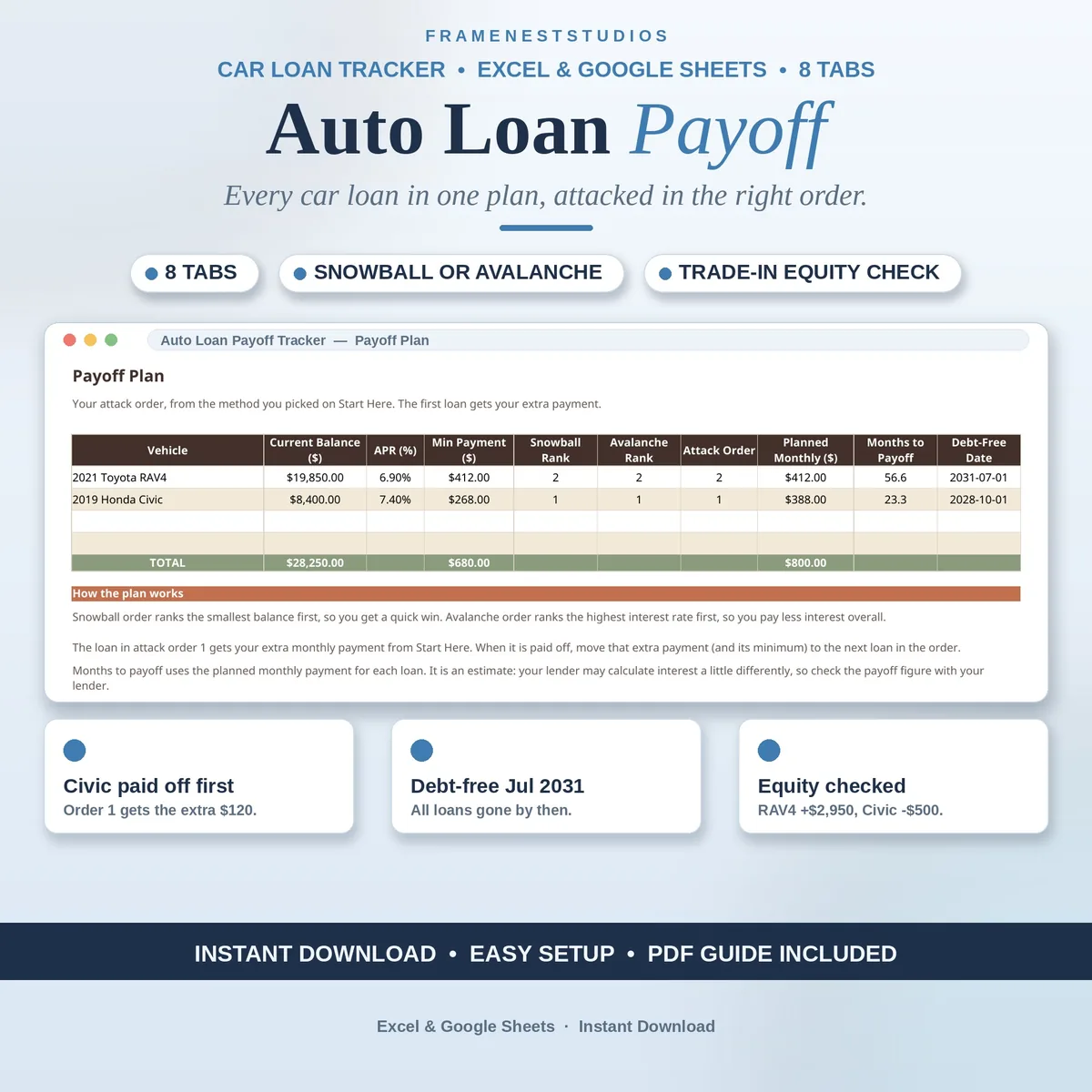
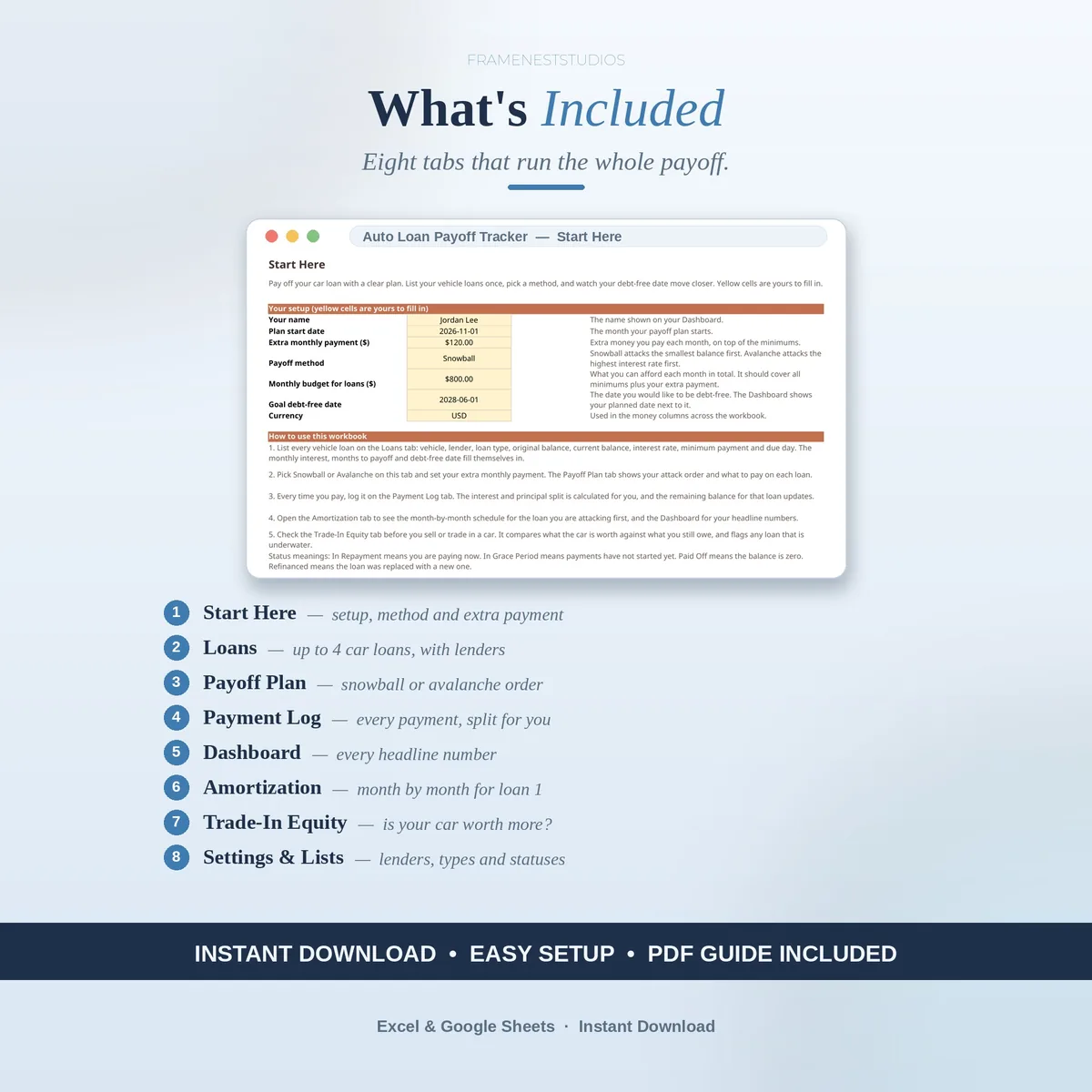
Short on time? The Auto Loan Payoff Tracker does this for you in Excel and Google Sheets.
Once you know your numbers, put them to work. Track every payment, watch the balance fall, and set your own payoff date. The calculator shows you the cost. The plan gets you to zero.
Up to 4 car loans, a snowball or avalanche plan, and your debt-free date. See every screen, the full tab list and buyer questions on the product page.
See the Auto Loan Payoff Tracker
Or browse more Debt & Loans templates.